Vision-led placemaking is a chance to put communities at the heart of transport planning


NicolaLodge
This environment, where policy makers typically look to new roads to solve congestion, comes despite the National Planning Policy Framework (NPPF) promoting policies that should prioritise walking, cycling and public transport. Instead, these services often go under-funded in new and existing developments.
However, the landscape is shifting. Vision-led Planning has gathered attention and now evidence as an alternative to the entrenched approaches of the UK’s infrastructure strategy. Instead of asking, "How much traffic will there be?" vision-led planners ask – often with the input of communities - "What kind of place do we want to build?" and design the transport network to achieve that outcome.
Nicola Lodge, an Associate Transport Planner at ITP, has been one of these vision-led planners. As a placemaking specialist, she leads active projects in our team, and recently co-authored a report, that has been endorsed by the Chartered Institution of Highways and Transportation, on Vision-led Planning and how we can plan development and transport infrastructure more sustainably. We spoke to Nicola to understand the approach and how it’s being applied in practice.


Q: What are the most common misconceptions about the relationship between new road construction, congestion and economic growth?
“That’s a good question, and there’s a growing body of evidence that’s addressing it. Historically we’ve equated travel times and particularly car travel times and congestion with a place’s ability to foster economic growth. Through this approach there are transport models and business cases that exist where the equivalent of maybe 5 minutes extra delay in the car can produce a low benefit to cost ratio – which in turn means a development won’t go ahead.“But when we consider this closely, it feels hard to imagine it’s true. That a few minutes’ delay could be the reason an active travel project, or public realm development, couldn’t go ahead. But this speaks to how much we have centred the car in our transport strategies over the years.
“While this thinking still prevails today, there is increasing evidence that the power of pedestrianisation and active travel, woven into developments, improves not reduces prosperity. The latest Pedestrian Pound report last year found that people walking spend up to 40% more than motorists in neighbourhood shops, while research on Low-Traffic Neighbourhoods in London found health gains up to 100-times greater than costs, with 500,000 sick days avoided.
“This evidence presents new ways to consider the potential economic benefits and growth of a development beyond cars and congestion.”
Q: How would you describe vision-led planning?
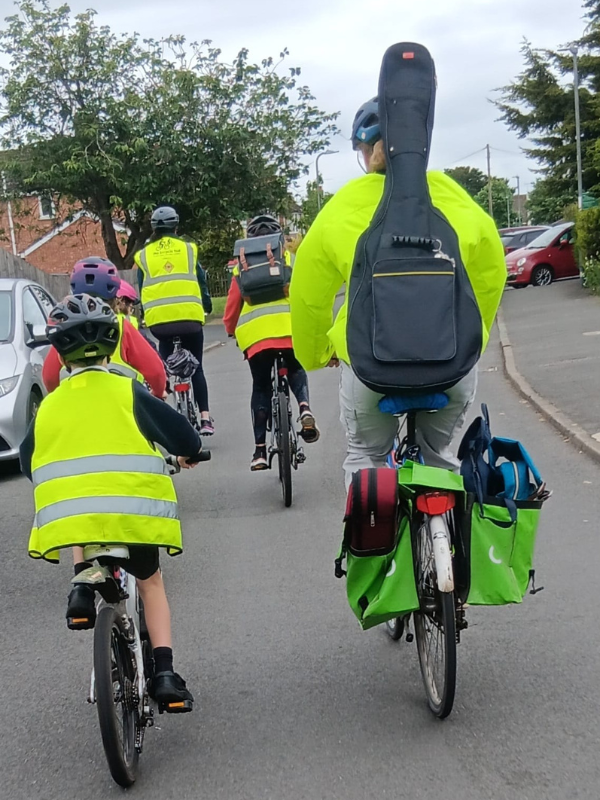
“Vision-led planning is about starting with a collective ambition for how a place could look and feel, rather than focussing on cars and roads. When communities are asked how they would like their local area to function, at the heart of their visions are places which are attractive, prosperous, safe, healthy, and easy to get around. The vision-led approach considers how transport and travel choices directly or indirectly influence these factors and sets out the interventions needed to achieve the right outcomes.”“As a formal term, vision-led planning is quite new and as it becomes established in policy it will drive this new way to think about transport and infrastructure planning on a national scale. But as an approach, it has been central to the work of me and my colleagues for some time, because we’re driven to create better places through good transport planning. To me, it’s about making what we do, and how we do it, better. We need to question, are we approaching things the right way at the minute? Are we getting the best outcomes? Are we applying technical veracity to everything we do?
“I think it’s important we ask these questions as an industry – to challenge conventions and norms – because how we’re doing things currently keeps leaving us with car-dependent places – with a lack of evidence that expanding roads and highway capacity solves congestion.”
Q: Why is shifting to this vision-led approach important?
“It’s important because it is a way to ensure more equitable, sustainable, healthy and safe places. And it doesn’t have to come at the cost of prosperity or stimulating the economy.“You can start a vision-led approach by simply being more holistic in approaching new development and how transport relates to it. Planning today has become overly focused on some factors and demographics – like congestion, delay or highway capacity – while others remain secondary. When we plan for places, for example, we often focus on commuters at certain points of the day, which means we overly account for white collar workers, but miss shift workers or other travellers at other times of the day. Equally, we don’t account for the fact that 50% of all people traveling in morning peak hours are going to schools and education. Have we thought about all these variants enough, and if we did, how would we plan places differently?
“And what if we measured carbon outcomes and health outcomes as much as we measured congestion? What would developments look like? At ITP, we believe by taking this more holistic view – focusing on sustainable transport connectivity from the outset – we help to reduce reliance on expensive infrastructure (e.g. road building), lower costs and actually improve viability to reduce objections.”
Q: What does vision-led Planning look like in practise?
“Well, I think it’s about asking a lot of questions and seeking robust answers, rather than taking too much of a templated approach. I’ve mentioned several questions in this discussion already, but you can start with first principles - Who am I planning for? Where are they going? When are they going there and why?“If you start with those building blocks and add them together, it will naturally lead you to the right outcomes and the right conclusions and the right way of assessing things. And I think if you can build that up in a logical narrative in your reports and assessments, you have a pretty compelling output.”
Q: Can you share an example of vision-led planning? And what made it work?
“As mentioned, the vision-led approach has been formalised relatively recently, so many formal examples are in early stages of planning and development, but we have embedded it into adopted policy and planning documents and even built-out projects.
"For example, our involvement in the sustainable transport strategy for Leeds Temple district with CEG has resulted in tangible outcomes. Rather than investing in a new multi-storey car park, resources were redirected towards creating a high-quality public realm, implementing lower speed limits, and introducing vehicle demand management. This represented a better use of developer contributions and led to different, more sustainable outcomes.
“What made these projects work was having collaborative clients—CEG, in particular, were willing to explore alternatives to the norm, driven by a genuine sense of responsibility to deliver more sustainable development."
Q: What would you say are the barriers to a vision-led approach?
“I think broadly the only barrier to a vision-led approach is the uncertainty that people can feel about the benefits, measurements and outcomes and heading in this new direction vs. what the kinds of transport strategies we’ve been deploying for decades.“I think this is in part because it is perhaps less tangible to define health outcomes as a measurement, for example, or the same with social or cultural benefits. Whereas the common data of waiting times, congestion and delay is defined by seconds and minutes.
“But as we’ve discussed, this is changing and evidence continues to grow. Our own belief in a vision-led approach is grounded and informed by this shifting landscape we’re seeing, and the outputs that are starting to come out that show how sustainable development benefits in many ways, not least in making more beautiful and enjoyable places to live and be. Our job is to support clients with the evidence base to make informed decisions using this approach, and then apply them in design.”
Q: If you could introduce one policy to improve development and transport planning, what would it be?
"If I could introduce one policy to improve development and transport planning, it would be a requirement to measure transport-related impacts on health, well-being, air quality, and road safety. It’s also crucial that underrepresented populations are properly considered in transport assessments—so a policy specifically worded to address these gaps is what I’d advocate for.“At present, the National Planning Policy Framework mainly asks us to think about safe access, mitigation, and severe impacts, focusing on aspects that are directly related to transport. However, we don’t currently assess many of these broader outcomes in our transport assessments. That’s why a policy along these lines would make a real difference."

Q: You’ve been involved in a working group called Fixing Transport Assessments (FTA) – how has that work aligned with the aims of vision led planning?
“The FTA group started a little before Vision-led Planning was a noted term, but the two things have grown to become quite aligned. The FTA group came as the Department for Transport (DfT) was exploring policy changes and changing transport assessment guidance – and I’d like to think we’ve had a hand in the DfT defining Vision-led Planning and embedding it into their policy. And vice versa, the thinking on what Vision-led Planning means comes from the work of the FTA group.”
Q: What are the next steps for the FTA working group?
“It’s an exciting time. Although we’ve now achieved our initial objective of lobbying the DfT on their transport assessment guidance and embedding vision-led, what we’re left with a is a legacy of a group of professionals that have good debates about the issues of our time.
Our experts are happy to assist you
Experts team Vision-led placemaking
Vision-led placemaking