Can the New Towns deliver good transport outcomes?


GeoffBurrage
The New Town proposals got a fair bit of national press recently but (perhaps unexpectedly) the national papers didn’t seem to pick up the DfT’s recently released connectivity dataset.
Unperturbed by the lack of media interest, in this blog I’ll run the New Town proposals through the connectivity data to see what it tells us.
Firstly, what does the connectivity data do? It scores every location in England and Wales, depending on how easy it is to reach day to day uses by different modes of transport.
Secondly, what conditions are most likely to make a new town a success in connectivity terms? Here are my three key conditions:
- Put them in the right place – the DfT data will help us with this
- Deliver them at the right scale – they should be big enough to have their own centre of gravity. Around 15,000 homes is a reasonable rule of thumb
- Work with the grain – locations close to existing settlements and networks will be cheaper to deliver, with benefits to existing communities
We’ve mapped the DfT’s data, which you can interrogate interactively below. This shows connectivity by sustainable modes (walking, cycling and public transport combined – the metric used throughout this blog), with the new town locations added.
Feel free to investigate your own sites and do let us know if we can help you analyse what the data is saying, identify deliverability challenges and opportunities, or come up with a best-in-class transport strategy!
There are some big differences in scale, location and how well-connected the New Town locations are. I’ll dig into this a bit more below.
New towns map
Location, location, location
The DfT gives a score of 100 to the best-connected place in the UK (no big surprises that it’s in central London) with zero going to the poorest-connected place (no surprise to me at least, only a mile from where I was brought up - south-west Wales). It’s worth noting that it is not just about transport services, it is also about how close you are to facilities. So, conceptually, a place could score well even with poor public transport.
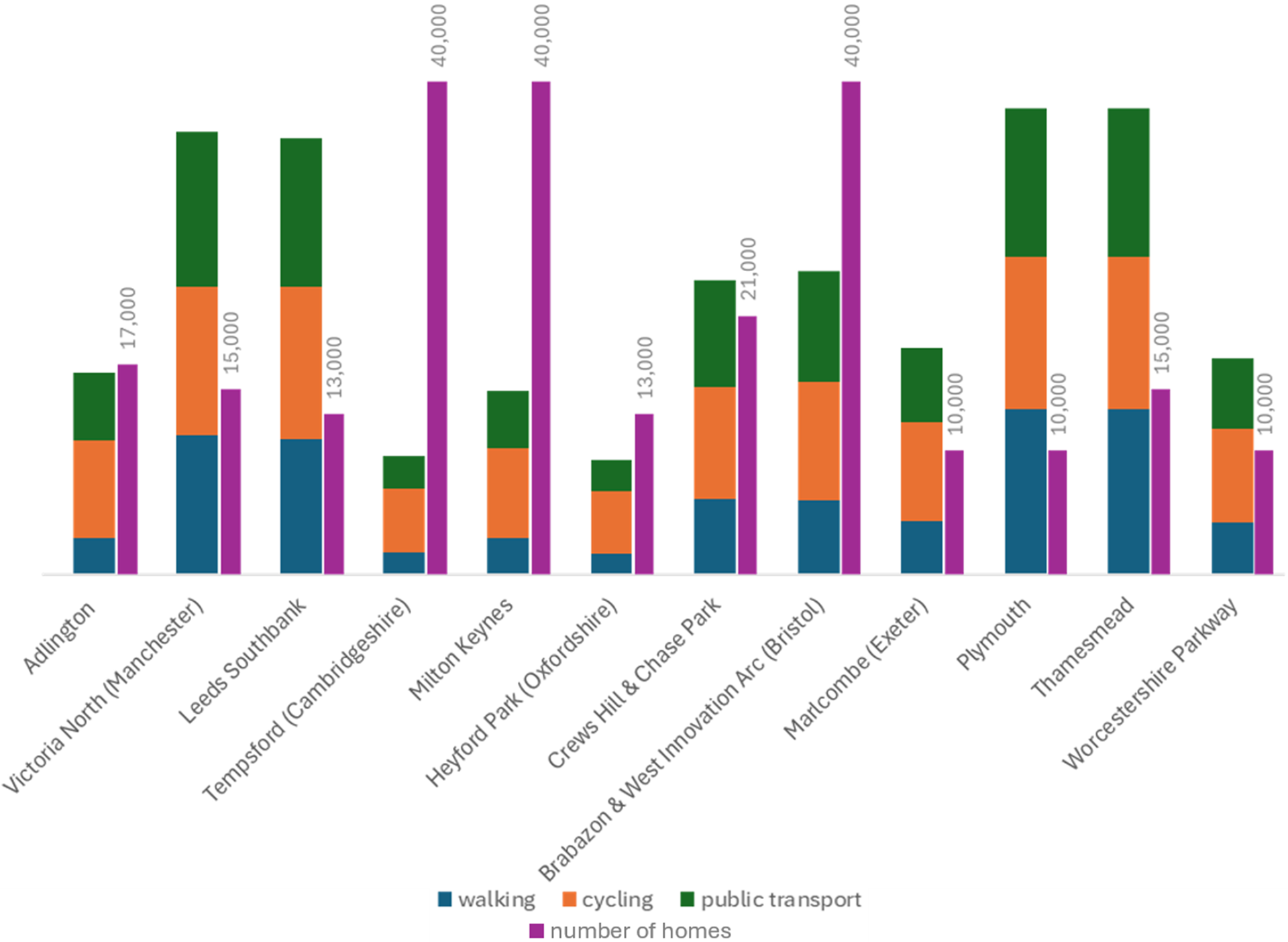
Focusing in on the twelve New Towns, we made a bar chart that stacks the scores for each mode we’re interested in (walking, cycling, public transport) on top of each other, alongside the number of homes proposed. Crudely speaking where the walking, cycling and public transport bars are small, you need to be considering a lot of homes to fund the facilities and transport connections needed to improve connectivity. On the flipside, where the number of homes are lower, there should be good existing connectivity.
Quick(ish) wins
As you’d expect, the New Town recommendations located in cities score well for connectivity – Victoria North (Manchester), Leeds Southbank, Plymouth and Thamesmead (London) all score around 80 out of 100. That’s important, as these sites are some of the smallest, with some well below my 15,000 home rule of thumb. I’m sure there will be plenty of delivery challenges to creatively resolve in such urban locations, but from a pure connectivity perspective they are ideal. In fact, ITP supported a vision-led masterplan for part of the land making up the Leeds Southbank proposal – so we are confident it is a great place for development at scale!
Long term safe bets
For the sites with lower connectivity, scale is critical. Bigger is better here, as it makes funding infrastructure viable and, critically, bigger sites can provide the day-to-day facilities necessary to keep as many trips on site as possible.
Let’s look at the middle ranking sites in connectivity terms first – Crews Hill & Chase Park (London) and Brabazon and West Innovation Arc (Bristol). These score around 60 out of 100. They are both larger sites though, with 21,000 and 40,000 homes respectively. At this scale they can build on their above average connectivity to existing facilities with well targeted improvements. For example, an extension of the London Overground to Crews Hill & Chase Park, and a new rail station at North Filton with integration to the Metrobus network in Bristol.
Also, in my ‘long term safe bets’ category are the biggest proposals for Tempsford and Milton Keynes. At around 40,000 homes each, these will be substantial New Towns around the size of Harlow (an ‘old’ new town), Chelmsford or Bath. They can provide a full range of facilities people need on site, including significant employment. ITP have worked on both of these locations, including developing the initial concepts for the Mass Rapid Transit network that will connect the Milton Keynes site to the city centre, and for Tempsford, considering how the site can best take advantage of the investment coming through East West rail. In both instances, getting public transport right will be critical to avoiding car dependency.
The Adlington site just about makes it into my long-term safe bet category. It has poor existing connectivity (36 out of 100) but with 17,000 homes it has the potential to deliver a full range of day-to-day facilities. Enhancing rail connectivity to Manchester and Crewe, along with new bus services and active travel routes, will be needed to improve connectivity.

Higher risk propositions
These are the sites where poorer existing connectivity and potential for a smaller number of homes combine to make sustainable outcomes most different to achieve.
Worcestershire Parkway (10,000 homes) scores 40 out of 100 for public transport connectivity. However, it will be wrapped around an existing Parkway rail station and it’s a stone’s throw from the city of Worcester. The key (transport) challenges will be getting the role of the station right – will it be a Parkway with lots of parking (bad) or the heart of a new town centre (good) – and strengthening bus and active travel links to the city.
The Marlcombe site is close to Exeter and is already partly allocated in an emerging local plan. The cost of housing in the region and Exeter’s status as a cultural hub in the region provide a logic to its inclusion. However, poor connectivity (40 out of 100) and challenging conditions for infrastructure delivery, including tricky administrative boundaries, will make it a hard one to deliver with sustainable travel outcomes.
Heyford Park is a brownfield site that has the benefit of being in single ownership and well placed to serve a high-value knowledge economy. However, it’s very poor connectivity (17 out of 100), lack of direct proximity to any settlements of scale and lower housing potential (around 13,000 homes) make it one of the hardest to deliver and achieve good transport outcomes.
Navigating the build baby bilge
New Towns will only represent a small part of the new housing needed in the UK, but even in these twelve sites – ostensibly some of the most promising in the country – we see many of the challenges faced for delivering housing more generally. With the right powers and funding in place, I am sure the programme can be a success (and move beyond the planner-bashing “build baby build” rhetoric). In my more optimistic moments I can even imagine that the proposed changes to strategic planning through devolution can usher in a new golden age of better coordinated planning across England and Wales.
Sustainable development
Discover our vision-led approach to planning new communities to embed sustainable commuting from the outset.


Our experts are happy to assist you
Experts team Sustainable development